

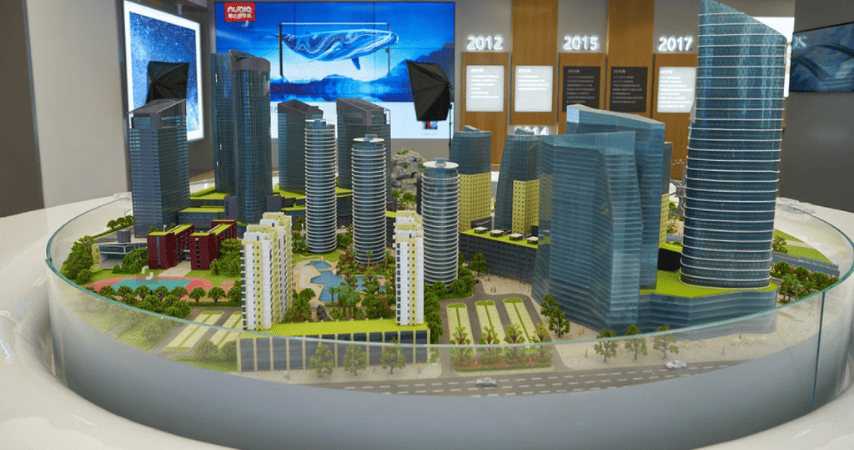
The sequence of tower construction in dense Dubai sites is often complex due to tight land parcels, overlapping functions, and fast-paced development timelines. To make this easier to communicate, teams rely on architectural scale models that break down each stage into clear layers. These models allow planners, engineers, and clients to see how a site evolves step by step, from excavation to the final façade.
They also help reduce confusion during coordination meetings because the visual breakdown is easier to understand than technical drawings. This approach becomes especially important in Dubai, where high-rise towers are closely spaced and construction activities affect surrounding streets, utilities, and existing buildings.
Early Excavation and Site Preparation Stages
The earliest stages focus on excavation, shoring installation, and site preparation. Scale models often include cutaway sections to display underground work. This helps the team see how deep foundations interact with nearby structures. In dense districts like Business Bay or Dubai Marina, limited space means each excavation step must be carefully planned to avoid disruption.
By showing the excavation phases in layers, the model clarifies how trucks, workers, and equipment will move around the site. Using architectural scale models Dubai at this stage improves communication between geotechnical teams and contractors because the physical form makes it easier to visualize the sequence.
Phased Core and Superstructure Growth
Once foundations are complete, the tower begins rising, usually through core-first construction. Scale models often show the vertical core in stepped layers, each layer representing a stage of progress. This method helps explain how the core climbs ahead of floor slabs.
In dense urban zones, understanding core progression is crucial because tower cranes, hoists, and temporary access points depend on that sequence. By placing transparent or semi-transparent layers in the model, teams can view the structural buildup without removing pieces. This clarity is valuable when coordinating vertical logistics, such as temporary lifts or mechanical risers.
Façade Installation Timing and Materials Movement
Façade installation is one of the most complex steps in high-rise projects, especially when towers stand close together. Scale models often highlight façade zones using color-coded sections to show when each part will be installed.
This helps explain how materials will be lifted and attached in tight areas. Since Dubai towers often feature reflective glass, shading fins, or composite cladding, showing façade stages in the model reduces misunderstandings about sequencing. This visual reference also helps teams plan crane swings, delivery schedules, and storage areas on crowded sites. With architectural scale models, these façade phases become clearer and easier to plan.
Temporary Works and Access Routes
Large tower projects require temporary roads, scaffolding, access ramps, and hoists. These elements often change as construction progresses. A physical model helps the team understand how workers, vehicles, and equipment will move through the site at each stage.
Temporary access changes are especially important in dense areas where streets cannot be fully closed. By showing short-term infrastructure in layers, the model helps planners avoid conflicts. It also clarifies how construction traffic interacts with surrounding roads and pedestrian paths. This improves safety planning and reduces disruption to nearby residents and businesses.
Podium, Retail Zones, and Shared Facilities
Many Dubai towers include podiums with retail, parking, or amenities. These podiums often need to be built before the tower advances too high. Scale models show how the podium fits into the sequence and how its completion affects tower access.
Because podiums often connect multiple buildings in a cluster, the model clarifies how construction stages overlap. This prevents scheduling mistakes that might delay vertical work. In mixed-use areas, podium construction also affects public realm spaces, so the model helps teams visualize when streetscapes and entrances will open.
Mechanical Floors and Service Integration
Mechanical floors, typically placed at intervals within the tower, require their own sequencing because they support major building systems. Models often highlight these levels by using a different material or color.
This helps teams plan installation timing for HVAC equipment, electrical rooms, and water systems. In dense sites, the movement of large equipment is challenging, so seeing the sequence in the model helps teams coordinate cranes, temporary openings, and service routes. With architectural scale models, the mechanical staging becomes easier to understand and schedule accurately.
Coordination With Surrounding Towers and Infrastructure
In Dubai, new towers are often built beside existing ones. Scale models help teams see how cranes, scaffolding, and temporary structures will interact with neighboring buildings. This prevents conflicts such as overlapping crane zones or blocked service entrances. The model can also show how construction affects daylight, wind flow, and pedestrian routes during different stages. This broader view supports better coordination with city authorities and neighboring developers.
Final Stages and Public Realm Completion
The last phases focus on façade completion, interior fit-outs, and public realm installation. Scale models display how streets, plazas, and landscape areas open gradually. This is useful for planning partial handovers, where some areas open while others remain under construction. The layered model approach makes these transitions clearer, especially when the project has multiple towers or phased occupancy plans.
Conclusion
Using architectural scale models to show tower construction sequences helps teams manage complex sites with clarity. By breaking down the process into understandable layers, the models support better scheduling, safer planning, and smoother coordination. This visual method is essential in dense Dubai locations, where tight boundaries and tall structures demand precise and well-communicated sequencing.

Leave a Reply